
By Meghan Connors, President of PipeSak Inc.
Featured in the World Pipelines magazine – September Edition 2025
The vast majority of oil and gas transmission pipelines are buried to protect both the pipeline and the surrounding environment. Pipelines are buried to prevent them from becoming barriers to people, vehicles, and wildlife; to reduce the risk of third-party damage (either accidental or intentional); to shield the pipe from weather exposure; and to protect the environment in the event of a pipeline failure.
While buried pipelines require additional weight to counteract the buoyant force of groundwater, they are often not considered at risk from natural hazards. In reality, floods, seismic activity, landslides, and soil movement can threaten pipeline integrity. For project managers and engineers working on oil and gas pipelines in the United States and Canada, designing an effective pipeline buoyancy control system in these areas must take potential soil and pipe movement into account.
Traditional Pipeline Buoyancy Control Methods
Buoyancy control of buried pipelines is a standard practice in regions where sections of the pipeline may be subject to uplift forces during construction or operation. Nearly all onshore pipelines cross buoyant environments at some point. According to Archimedes’ principle, the upward buoyant force equals the weight of the displaced water, making large-diameter pipelines particularly vulnerable to flotation. While each of these methods can achieve negative buoyancy, they vary in performance under soil movement and natural hazard conditions.
Historically, one solution was to increase the pipe wall thickness to make it heavier than the displaced water. However, this approach is impractical, and the industry has evolved to use external buoyancy control systems such as:
- Concrete set-on weights
- Concrete-coated pipe
- Helical screw anchors
- Geotextile pipeline weights
Limitations of Concrete Set-On Weights
The first external buoyancy control systems used bolt-on cast iron weights, eventually replaced by pre-formed concrete weights and saddle-style set-on weights. Concrete set-on weights allow flexibility during installation but are top-heavy and unstable, particularly in semi-aquatic areas. If trench conditions are not firm and dry, these weights can tip during installation, reducing buoyancy control and damaging the pipeline coating.
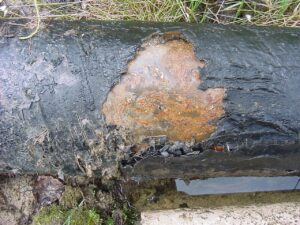
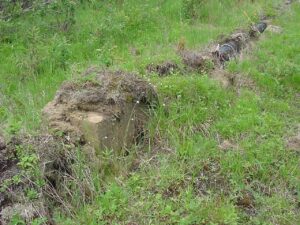
Risks don’t end after backfilling. In areas prone to flooding, erosion, or seismic activity, shifting set-on weights can create a domino effect—causing entire sections of a pipeline to lose stability, float, and even expose pipe to the surface. In addition, removal of deteriorated concrete weights on live pipelines can be hazardous, as corroded rebar and lifting loops often make them unsafe to handle.
Limitations of Concrete-Coated Pipe
Concrete coating the full pipeline length can provide buoyancy control and added protection during construction. However, achieving the required thickness for buoyancy control makes the pipe 4–5 times heavier, dramatically increasing transportation and handling costs. Field-applied coatings reduce some costs but are slow and can delay construction and:
- Increase stress on pipelines in eroded soils
- Limit flexibility during flood or seismic events
- Add significant costs for handling, transport, and installation
Concrete coatings are a rigid method of negative buoyancy. While it was once thought that it was ideal for all onshore applications, we now know that it is not only extremely expensive but also not suitable in areas at risk of ground movement, particularly by erosion and flooding. The reasoning behind this is two-fold:
- The increased weight of the pipe makes it susceptible to lengthening and bending if the soil around the pipe erodes away
- The inability of the pipe to flex under pressure can cause kinks and breaks if it is subject to the sustained force of flood water.
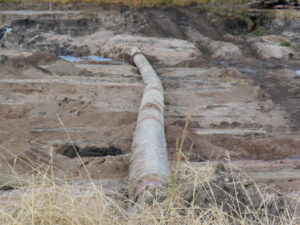
A classic example of this occurred during the 2013 Colorado floods that washed out several pipelines, including a 20” O.D. concrete-coated pipeline. During the floods large sections of the pipeline were exposed and subject to sustained pressure from the fast-moving flood waters. Figure 3 clearly depicts a section of pipe that kinked under the pressure of the wet soil and water. Without immediate corrective action, this natural disaster could have quickly escalated to a full-out pipeline rupture.
Buoyancy control systems in areas subject to natural hazards such as flooding and ground movement should allow the pipeline the ability to flex and move with the shifting soils while maintaining negative buoyancy. Geotextile pipeline weights (GPW) offer a solution that both unstable concrete set on weights and the heavy and rigid concrete coated pipe do not – by offering a soft, stable method of buoyancy control.
Geotextile Pipeline Weights: A Safer, Proven Alternative
In areas prone to flooding, erosion, or ground movement, buoyancy control must allow flexibility while maintaining stability. Geotextile pipeline weights (GPWs) offer a solution that concrete-based systems cannot: a soft, stable, and long-lasting method of buoyancy control.
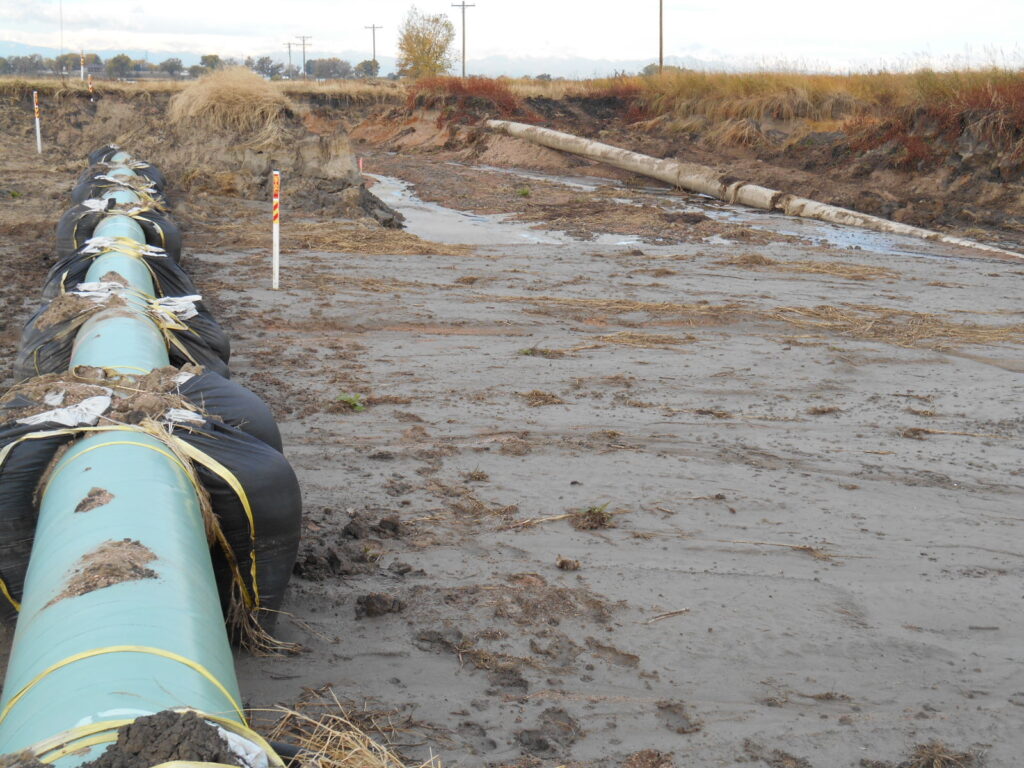
Developed by PipeSak® Pipeline Products in the early 1990s, geotextile pipeline bag weights are now a trusted solution across North America. For over 30 years, PipeSak geotextile pipeline weights have provided project managers and engineers with a safe, economical, and proven way to address pipeline buoyancy control challenges in onshore oil and gas projects.
During the 2013 Colorado flooding, a 30″ pipeline stabilized with PipeSak geotextile pipeline bag weights remained in position, while a nearby 20″ concrete-coated pipeline suffered deformation. The difference demonstrates how weights protect pipelines under extreme conditions.
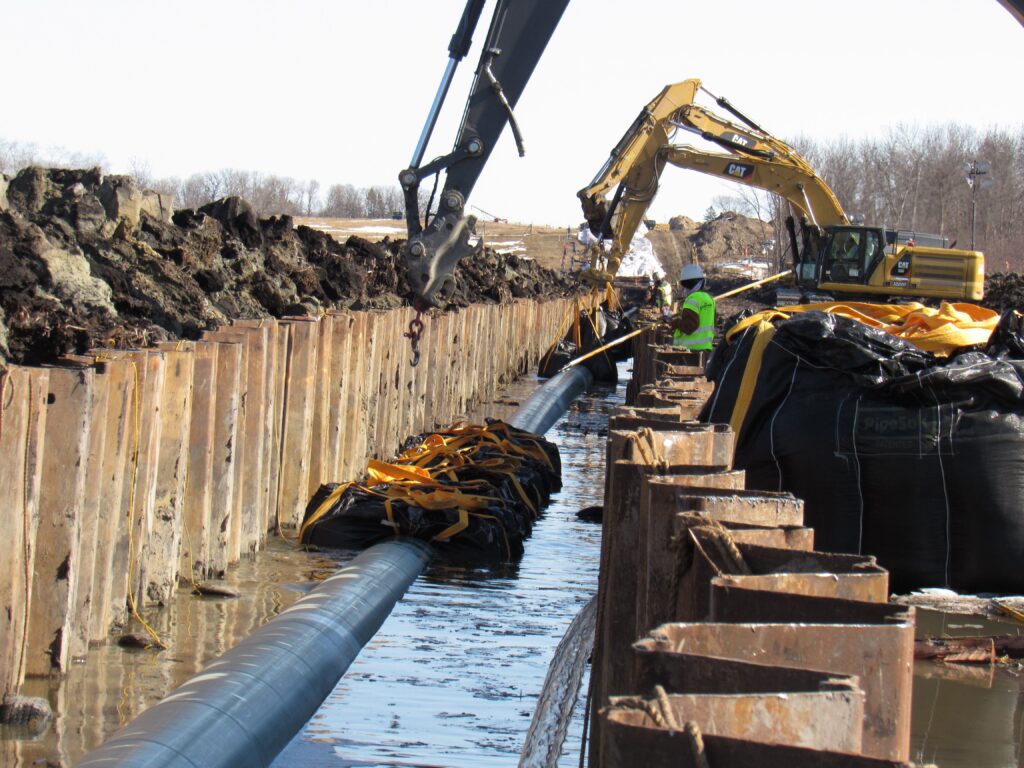
Why PipeSak® Geotextile Pipeline Weights Work
- Low center of gravity: Weight distributed along the sides of the pipe for superior stability
- Installable on floating pipe: Enables flexibility during construction
- Permeable design: Allows water flow through aggregates, reducing uplift pressure and shielding effects on cathodic protection
- Wide base support: Prevents further sinking if soils become unstable
- Responsive buoyancy: Weight activates during high groundwater, minimizing unnecessary load at other times
By combining flexibility, permeability, and stability, geotextile pipeline bag weights maintain pipeline integrity even in areas prone to soil movement, seismic activity, or flooding.
Conclusion
For oil and gas project managers and engineers in Canada and the U.S., selecting the right buoyancy control method is critical for long-term pipeline integrity and safety. Traditional methods like concrete set-on weights and concrete coatings add unnecessary risks and costs, especially in disaster-prone regions.
PipeSak® Geotextile Pipeline Weights provide a cost-effective, stable, and proven solution for onshore oil and gas pipelines. By offering flexibility, stability, a unique multichamber design and duffel-top, PipeSaks represent the safest way to ensure effective buoyancy control in challenging environments. Learn more about PipeSak below or contact us for more information.
Author Bio: Meghan Connors is President of PipeSak Inc. and leads strategic growth, customer engagement, and industry outreach.
Quick Links & Further Reading
Discover more insights and best practices for protecting your pipelines with the resources below:
- Pipeline Buoyancy Control Solutions – An overview of buoyancy control challenges and engineered solutions.
- RockShield & Pipe Protection Systems – Protecting pipelines from backfill damage and geohazards.
- Why Geotextile Pipeline Weights Work – A deeper dive into GPW performance in flood-prone and unstable soil conditions.
- A Crash Course on Pipeline Ovality – Understanding the risks of ovality and how to prevent it during construction.
- Visit the PipeSak Blog – Stay updated on pipeline integrity, buoyancy control, and construction best practices.
Read more about projects featuring PipeSak® geotextile weights
About PipeSak®
At PipeSak Incorporated, we are committed to delivering engineered solutions that protect pipelines, the environment, and communities. For more than 30 years, project managers and engineers across Canada and the United States have trusted us to provide innovative products that ensure long-term pipeline integrity, safety, and cost efficiency.
Our flagship solution, PipeSaks, is just one example of how we combine engineering expertise with practical construction needs for all-around protection. For a complete pipeline protection solution, ask us about our heavy-duty rock shields, pipe pillow supports, and even pipeline lagging for extreme conditions. PipeSak is your one-stop shop that always stands for:
- Reliability – proven solutions tested in the most challenging conditions
- Innovation – products designed to address real-world buoyancy control and protection issues
- Safety & Environmental Responsibility – solutions that protect both pipelines and surrounding ecosystems
Project managers and engineers rely on PipeSak because we understand the unique challenges of oil and gas pipeline construction and provide industry-leading products that reduce risk, lower costs, and deliver long-term peace of mind.
Contact PipeSak to learn more about how to get the best protection for your projects.
